
10 Early Warning Signs and Symptoms of Myositis You Shouldn't Ignore
Learn about the 10 critical early warning signs and symptoms of myositis. Recognizing these can lead to early diagnosis and better management of the condition.
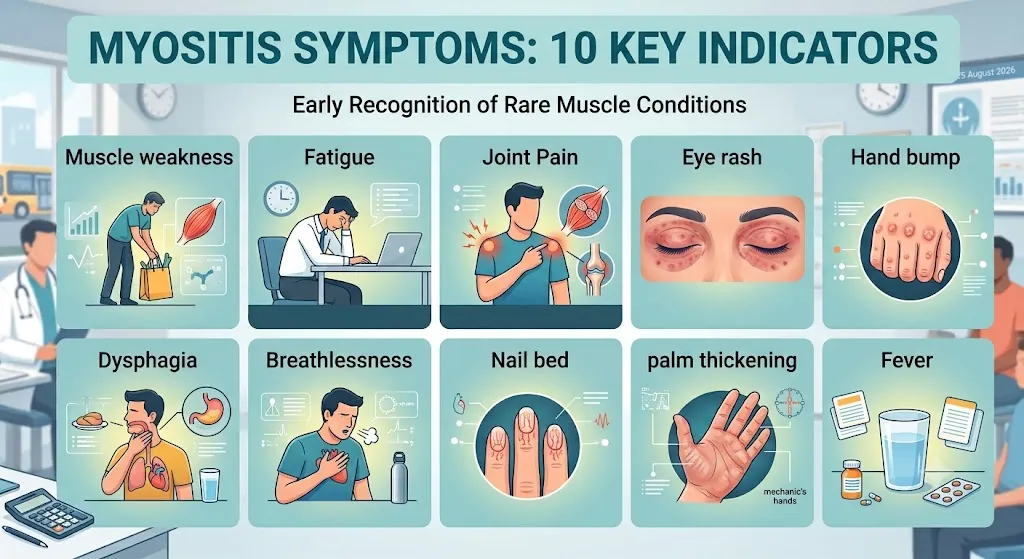
Myositis can begin quietly. A person may notice that climbing stairs has suddenly become harder, getting up from a chair takes more effort, or fatigue seems unusually persistent. These changes are easy to blame on stress, ageing, a busy routine, or a lack of exercise. But when muscle weakness or other symptoms continue without a clear explanation, they deserve medical attention.
Myositis refers to a group of rare inflammatory muscle diseases in which the immune system mistakenly attacks muscle tissue. Some forms can also affect the skin, lungs, joints and muscles involved in swallowing. Recognising the early signs can help doctors investigate the right causes sooner and begin appropriate care.
Here are ten symptoms that should not simply be brushed aside.
1. Persistent, unexplained muscle weakness
One of the most important myositis symptoms is weakness in the muscles close to the centre of the body. This often affects the hips, thighs, shoulders and neck.
A person may struggle to rise from a chair, climb stairs, get out of bed, lift objects or raise the arms above the head. The important distinction is that this is weakness rather than ordinary muscle soreness. It can gradually interfere with everyday activities that were previously effortless.
Inclusion body myositis often follows a different pattern, with prominent weakness of the deep finger flexors and quadriceps muscles, sometimes asymmetrically.
2. Fatigue that does not improve with rest
Everyone feels tired sometimes. Persistent fatigue is different.
Some people with myositis describe an exhaustion that makes ordinary activities feel disproportionately difficult. Getting through a workday, preparing a meal or completing household tasks may require much more effort than before.
Fatigue can have several causes, including inflammation, muscle weakness, poor sleep, medication effects and other medical conditions. On its own, it does not diagnose myositis. But persistent fatigue combined with muscle weakness or other inflammatory symptoms warrants discussion with a doctor.
3. Unexplained skin rashes
Certain skin changes can be an important clue, particularly in dermatomyositis.
A reddish or purple rash may appear around the eyelids, over the knuckles, across the upper chest or on the back. Some people develop increased sensitivity to sunlight or distinctive rashes known as Gottron's papules, the V-sign or the shawl sign.
These rashes can initially be mistaken for eczema, an allergy, sunburn or another common skin problem. When a persistent rash occurs alongside muscle weakness, a dermatologist or rheumatologist may need to consider dermatomyositis.
4. Persistent inflammatory joint symptoms
Morning stiffness is common in several inflammatory and autoimmune conditions. Stiffness that persists for a significant period after waking, particularly when accompanied by joint pain, swelling or muscle weakness, should not be ignored.
Myositis can occur alongside inflammatory joint symptoms, particularly in conditions such as antisynthetase syndrome. This means stiffness may be part of a wider pattern rather than an isolated joint problem.
The duration and pattern of stiffness are useful details to share with a doctor.
5. Difficulty swallowing
Swallowing difficulties, medically called dysphagia, can occur when myositis affects the muscles involved in swallowing.
Warning signs include food feeling stuck, coughing or choking while eating or drinking, difficulty swallowing solid foods, regurgitation or taking unusually long to finish meals.
This symptom deserves prompt medical assessment because swallowing problems can increase the risk of food or liquid entering the lungs. Significant or rapidly worsening difficulty swallowing should receive urgent medical attention.
6. Unexplained fever or other systemic symptoms without an obvious infection
A low-grade fever can occur with inflammation, although fever is not specific to myositis.
If fevers repeatedly occur without a clear infection, especially alongside muscle weakness, fatigue, rashes, joint symptoms or weight loss, a doctor may investigate inflammatory and autoimmune causes among other possibilities.
It is important not to assume that every unexplained fever is autoimmune. Infection and other causes need to be considered and ruled out appropriately.
7. Abnormal muscle enzyme or inflammatory blood tests
Blood tests can provide important clues during a myositis diagnosis.
Creatine kinase, also called CK or CPK, is commonly measured because muscle injury can cause its level to rise. Doctors may also assess aldolase, LDH, AST and ALT, along with inflammatory markers such as ESR and CRP.
However, blood tests cannot confirm or exclude myositis on their own. Some patients, particularly those with certain subtypes, may have normal or only mildly elevated muscle enzymes. Doctors therefore interpret laboratory results alongside symptoms, examination findings, imaging, autoantibody testing and, when necessary, muscle or skin biopsy.
8. Unexplained shortness of breath
Myositis does not always remain limited to the muscles.
Some patients develop interstitial lung disease, particularly in association with antisynthetase syndrome and certain myositis-specific antibodies. Shortness of breath, a persistent dry cough or reduced exercise tolerance can therefore be important warning signs.
Breathing difficulties should never automatically be attributed to poor fitness or fatigue. A doctor may recommend lung function testing and imaging if lung involvement is suspected.
9. Persistent joint pain or swelling
Joint pain and swelling can occur alongside inflammatory muscle disease. In some patients, joint symptoms appear before the diagnosis of myositis becomes clear.
Persistent or recurrent joint symptoms, especially when combined with weakness, fatigue, skin changes or abnormal blood tests, may point towards an underlying inflammatory condition.
A complete clinical history matters because myositis can overlap with other autoimmune diseases, and identifying the broader pattern can help guide further testing.
10. Significant unexplained weight loss
Unintentional weight loss is another symptom that should be investigated rather than ignored.
Weight can fall because eating becomes difficult, particularly when swallowing muscles are affected. Severe illness can also reduce appetite and muscle mass. In some people with myositis, particularly certain higher-risk forms of dermatomyositis, unexplained weight loss may also prompt doctors to investigate an underlying malignancy.
This does not mean that weight loss automatically indicates cancer. It simply makes proper medical evaluation particularly important.
Why early evaluation matters
These symptoms do not necessarily mean that someone has myositis. Many can occur in infections, nutritional deficiencies, thyroid disorders, neurological conditions and other autoimmune diseases. What matters is the pattern, persistence and combination of symptoms.
A myositis diagnosis usually involves several pieces of evidence rather than one definitive test. Doctors may assess muscle strength, check CK and other enzymes, perform myositis-specific antibody testing, and use MRI or electromyography. In selected cases, a muscle or skin biopsy may be required. Additional tests may be needed when swallowing, breathing or other organs are involved.
For patients in India, reaching the right specialist can make an important difference. A rheumatologist, neurologist or another physician experienced in inflammatory muscle disease can help connect the symptoms and decide which investigations are appropriate.
Do not wait for weakness to become severe
Myositis can look different from one person to another. One person may first notice difficulty climbing stairs. Another may develop a skin rash, swallowing difficulty or breathing problems. That is why recognising patterns is so important.
If unexplained muscle weakness, persistent fatigue, characteristic skin changes or any of the symptoms above continue or worsen, seeking medical advice early is a sensible step. An early evaluation does not guarantee a myositis diagnosis, but it can prevent months of uncertainty and help identify the right treatment when an inflammatory muscle disease is present.
The goal of myositis treatment is to control inflammation, preserve muscle strength, manage complications and help patients maintain their quality of life. The earlier the underlying problem is recognised, the sooner appropriate care can begin.